Outdoor & Event Lighting
Permanent Lighting Maintenance: What It Actually Needs

TL;DR
- Turn the system on once a month, even in the off-season. This is the single most useful thing you can do, and the one people skip.
- Clean it about once a year, when you are already doing windows or gutters. Soft cloth or gentle rinse. No pressure washer.
- Check it after serious weather, meaning high wind or heavy ice, not every storm.
- Call your installer before any roof, solar, gutter or siding work. This is the one that costs people money when they forget.
- Expect the controller to need replacing at seven to ten years. The LEDs will outlast it by a decade.
- Most installations look good for ten to fifteen years before any major component needs attention.
- Nothing comes down for winter. Snow, ice, and wind are not the problem. Poor installation is.
- Anyone promising a completely maintenance-free system is selling, not explaining.
"Maintenance free" is a sales phrase, not a specification
You will see that phrase on a lot of permanent lighting websites. It is close enough to true that nobody gets sued over it, and far enough from true that it is worth unpicking.
A permanent system genuinely removes almost all of the work you associate with exterior lighting. Nothing comes down in January. Nothing gets stored in a box in the garage. You are not on a ladder in December, and you are not replacing a strand every couple of seasons because the last one gave up.
But it is still hardware, mounted outside, in southern Idaho, going through freeze and thaw every winter and hard sun every summer. Hardware in that situation eventually needs something. The useful question is not whether it needs anything. It is what, and how often, and how much of it falls to you.
Here is the honest version.
What you actually do
Turn it on once a month. This is the only item on the list that people skip, and it is the one that matters most. The manufacturer of the system we fit recommends running your lights at least monthly, and ideally weekly, even in the off-season. The reason is simple. If a fault has developed, you want to find it in March when nothing depends on it, not on the twentieth of December when you have family arriving. A system that gets switched on regularly is a system where problems surface early and get fixed quietly.
Clean it when you are already cleaning something else. Dust, pollen, cobwebs, and the general film that settles on anything mounted under an eave will dull the output over a few seasons. It is not urgent. Once a year, when the windows or gutters are being done anyway, is plenty. Use a soft cloth or a gentle rinse. Do not put a pressure washer near the track, the connections, or the controller. High-pressure water is one of the few things that will genuinely damage a system that would otherwise have been fine.
Look at it after serious weather. Not every storm. But after high wind, a heavy ice event, or anything that has taken branches down in your yard, switch the lights on that evening and look at the roofline. If a section is dark or a color is off, you have found it immediately rather than months later.
Tell us before anyone works on your roof. This is the big one, and it is the failure mode that costs people money. Roofing crews, solar installers, gutter replacements, and siding work all involve people working exactly where your lighting lives. A crew that does not know the track is there, or does not know how it comes off, can damage it, and damage caused during someone else's job is not a warranty claim. A short phone call before the work starts is usually all it takes. In many cases, the run can be detached and reset properly around the other trade.
That is the list. Four things, three of which take minutes, one of which is a phone call you make every several years.
What wears out, and roughly when
This is the part almost nobody publishes, so here it is plainly.
The LEDs themselves last the longest. Quality LED chips in this category are rated at around 50,000 hours of use, which works out to roughly fifteen to twenty years on a normal residential schedule. They also tend not to fail outright. They dim, gradually, over a long period. You are unlikely to notice it happening and unlikely to be bothered by it when it has.
The controller and electronics go first. Seven to ten years is the realistic expectation for the control side of the system. It is the component doing the most work, holding the schedules and the scenes and the connection to your phone. It is also, fortunately, the cheapest and easiest part to replace, because it is a single unit rather than something running the length of your roof.
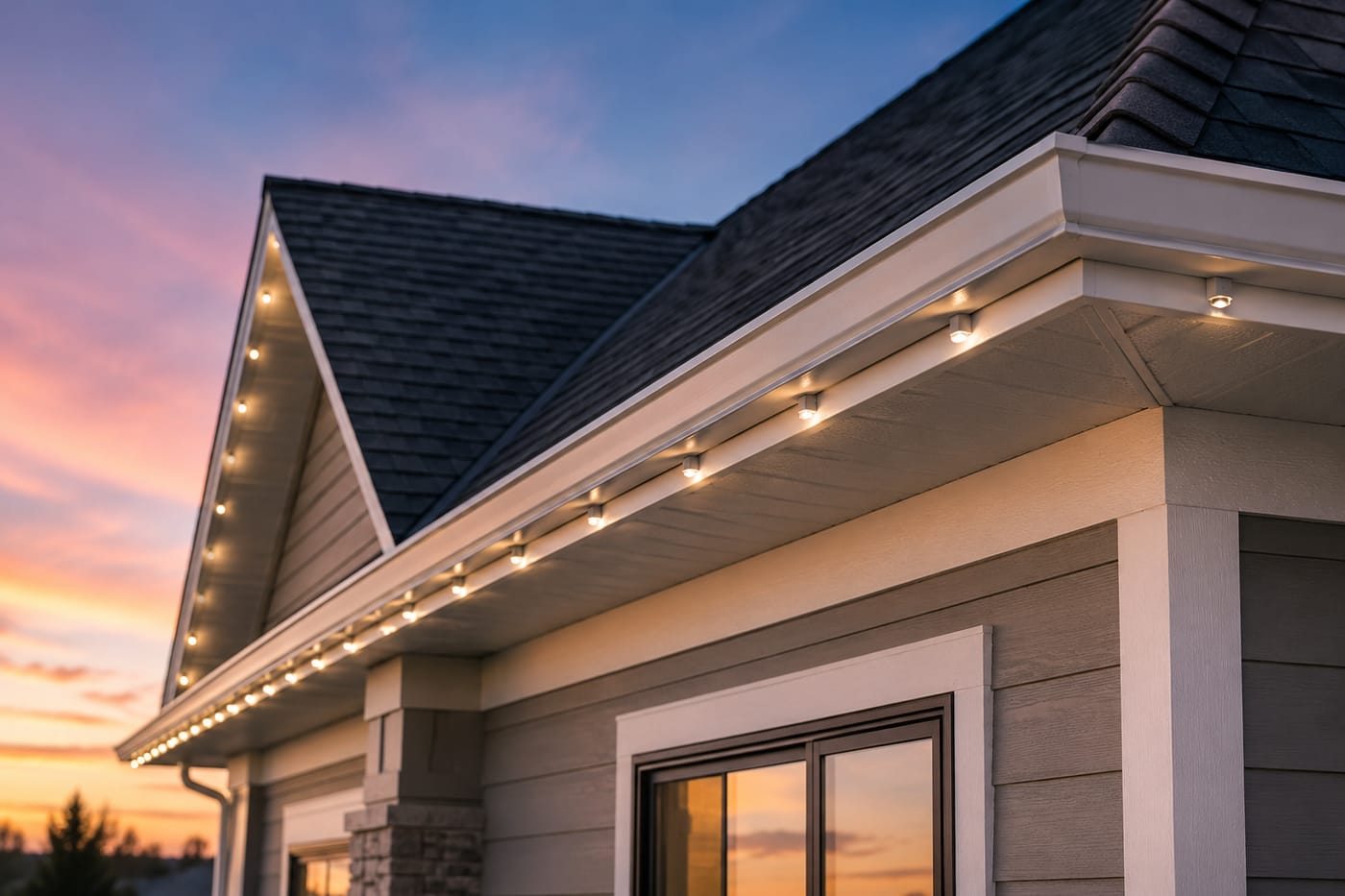
The track and channel sit somewhere in between. Ten to twenty years and up, depending on the material and, more than anything, on how well it was fitted in the first place.
Put together: most installations look good for ten to fifteen years before any major component needs attention. That is a long time for anything mounted outside, and it compares well against the alternative, which is buying and replacing seasonal strands every few years forever.
What an Idaho winter does, and what it does not
Systems built for permanent outdoor use are built for exactly this. Snow sitting on the track does nothing. Ice does nothing. Wind does nothing, because there is no strand to catch it. There is nothing to take down before a storm and nothing to check after one for safety reasons.
What tests a system, slowly, over years, is the cycling. Southern Idaho puts exterior materials through repeated freeze and thaw, seasonal expansion and contraction, and then a dry summer with a lot of ultraviolet. None of that will break a properly fitted system. All of it will find a poorly fitted one. Fixings that were not set correctly work loose. Connections that were not sealed properly let moisture in. Track that was fitted without allowance for movement can distort.
This is the honest reason installation quality matters more than brand, and it is why the failures people blame on products are usually failures of the day the product went up.
When one section goes dark
It happens. Usually it is not what people fear.
The common causes are a connection or data issue affecting a run, rather than a stretch of dead LEDs. That is good news, because it is generally a quick fix. A section that has gone dark from the corner onward is behaving very differently from a section that has gone dark in patches, and either way it is diagnosable from the ground before anyone gets a ladder out.
What you should not do is start pulling at the track. What you should do is call whoever installed it.
The warranty question people ask backwards
Most people ask how long the warranty is. The more useful question is what it covers, and who is standing behind each part of it.
Permanent lighting warranties usually split in two. The manufacturer covers the parts. The installer covers the labor. Those are separate promises from separate companies, and a long manufacturer warranty is worth considerably less than it sounds if nobody local will come out and do the work.
This is not our opinion. The manufacturer of the system we fit explicitly recommends that anyone having their product installed by a third party should get a labor warranty and a maintenance arrangement from that installer as well. The company making the product is telling you, in writing, that its own parts coverage is not the whole picture.
So when you are comparing quotes, ask:
- Is this a parts warranty, a labor warranty, or both?
- Who physically comes out when something fails, and are they local?
- What is the call-out cost once the first year is up?
- What voids it? Improper installation and using non-manufacturer components usually will.
- What happens if I need my roof replaced in year six?
Ask every company those questions, including us. A company confident in its answers will not mind.
Why any of this matters
Permanent lighting is a genuinely low-maintenance product. We would rather tell you the small amount it does need than pretend it needs nothing and let you discover the gap yourself.
There is also a practical reason we are specific about it. When a company promises zero service forever, it has quietly told you what its plans are for the day you call. Companies that gloss over maintenance are usually the ones with the weakest support after the sale. The people who fitted your lights should be the people who fix them, and they should be near enough to come.
We install across the Magic Valley and we service what we install. If your system is doing something it should not be, whether we fitted it or not, it is a local call rather than a support ticket in another state.
Ready to talk about your building?
Tell us about your home or business and we will walk it, design it, fit it, then hand you the app in person. Free quote, no obligation, and it comes from someone who has actually looked at the place.
Get my free quote or call (208) 242-4252.
Frequently asked questions
Do permanent outdoor lights need to be taken down in winter?
No. That is the entire point of a permanent system. There is nothing to remove before a storm and nothing to store. Snow and ice sitting on the track do not harm it.
How often should I clean permanent lighting?
About once a year is plenty for most homes. Fold it into whatever you already do for windows or gutters. If you are under heavy tree cover or in a dusty spot, twice a year is reasonable.
Can I pressure wash my house with permanent lighting installed?
Wash the house, but keep high-pressure water away from the track, the connections, and the controller. Pressure washing is one of the few things that will damage a system that would otherwise have been fine. If your siding is being professionally washed, tell the crew the lighting is there.
How long do permanent outdoor lights last?
The LEDs are rated at roughly 50,000 hours, which is about fifteen to twenty years of normal residential use, and they dim rather than fail outright. Controllers typically last seven to ten years. Most installations look good for ten to fifteen years before any major component needs replacing.
What should I do if one section stops working?
Call whoever installed it. Do not pull at the track or try to reseat connections yourself, because that is how a small fault becomes a bigger one. Most section failures are a connection or data issue rather than dead LEDs, which usually means a quick fix.
Will replacing my roof damage my permanent lighting?
It can, if nobody tells the roofing crew the system is there. Call your installer before roof, solar, gutter or siding work starts. Damage caused during another trade's job is not a warranty claim, and in most cases the affected runs can be detached and reset properly around the work.
Do permanent lights use a lot of electricity?
No. LED systems draw very little, and most owners run warm white for a few hours in the evening rather than full color at full brightness. The everyday setting most people settle on is the least demanding one.
Does the app or system need updating?
Occasionally. Control systems get firmware, and apps update the same way any connected device does. It is not something you need to monitor, but if you are prompted to update, do it.
Do I need to do anything before winter?
Not really. Switch the system on and check the roofline looks right before the season you most want it working, which for most people means sometime in October. That is less winter preparation and more a sensible habit.
Will you service a system another company installed?
Often, yes. Give us a call and describe what it is doing. We will tell you honestly whether it is something we can help with.