Event Lighting Guides
Why 100,000+ Homes Switched to Permanent Lighting
TL;DR
- Permanent roofline lighting is about sixteen years old. The first track-and-bulb system came to market in 2010. Before that, there was no such product.
- More than 100,000 American homes now have it, and the number climbs every year.
- That is the useful part. It is old enough that the early installations have been through fifteen winters, and new enough that most people have never heard of it.
- People switch for five reasons: they are finished with ladders, they are tired of paying for the same job every year, they end up using it far more than three weeks in December, it works as security lighting, and it looks better than strands.
- The biggest surprise for owners is how much they run plain warm white on ordinary evenings.
- It is not right for everyone. Four situations where we would tell you not to bother are below.
- The thing to vet now is the installer, not the brand. A category growing this fast attracts people who were doing something else last year.
Nobody had this in 2009
It is worth sitting with that for a second, because it explains why you might be reading about it for the first time.
Before 2010, if you wanted your house lit for Christmas, you had exactly two options. Put strands up yourself, or pay somebody to put strands up. Both came down in January. That was the entire market, and it had been the entire market for about a century.
Then in 2010 a company brought out the first permanent system built on a track: a slim channel fitted into the eave line, holding individually controllable LEDs, wired to a controller rather than a wall socket. A second major brand followed around 2015, its founder having been working on colour-changing exterior lights since 2011. Others arrived after that.
Today more than 100,000 American homes have a permanent system on the roofline, and that number grows every year.
Here is why that history matters to you, and it is not the number. Sixteen years is a specific and quite useful window. It is long enough that the earliest installations have now sat through fifteen winters, which is the only real test exterior hardware ever gets. It is short enough that most people, including plenty in the Magic Valley, have never heard of the product and assume anything they have not heard of must be unproven.
Both things are true at once. It is unfamiliar, and it is settled. Those feel like opposites and they are not.
So the question worth asking is not whether it works. It is why people keep switching. Here is what they actually tell us.
They are finished with ladders
This is the most common trigger by a distance, and it usually arrives as a decision about something other than lighting.
Someone turns sixty. Someone has a bad afternoon on an icy driveway. Someone's spouse announces they are not doing it any more. A two-storey roofline in southern Idaho in late November is a genuinely hazardous place to be, and the person most likely to be up there is often the person least suited to it.
Then there is the routine itself. Haul the boxes down, find a third of the strands dead, drive out for replacements, lose a Saturday in the cold, then do the whole thing in reverse in January when the weather is worse and nobody is in the mood.
Permanent lighting ends that for good. It goes up once, professionally, and you do not touch it again. For a lot of our customers that is the entire decision, and everything below is something they discovered afterwards.
They are tired of paying every year for the same job
The second big trigger is people who stopped climbing years ago and started hiring instead.
Seasonal installation is honest work and the crews doing it earn their money in bad conditions. But it has a structural problem from the customer's side: you pay again every year, indefinitely, and at the end of it you own nothing. Up in November, down in January, back to a bare roofline, minus the money.
A permanent system inverts that. You pay once for something that stays. Whether the arithmetic works for you depends on your roofline and what you are currently spending, which is precisely why we walk the building before quoting rather than measuring off a satellite photo. But if you are already paying somebody every year, the comparison is worth doing properly, and most people have never sat down and done it.
They use it far more than they expected to
This is the one that catches people out, and it is the reason we do not describe ourselves as a Christmas lighting company.
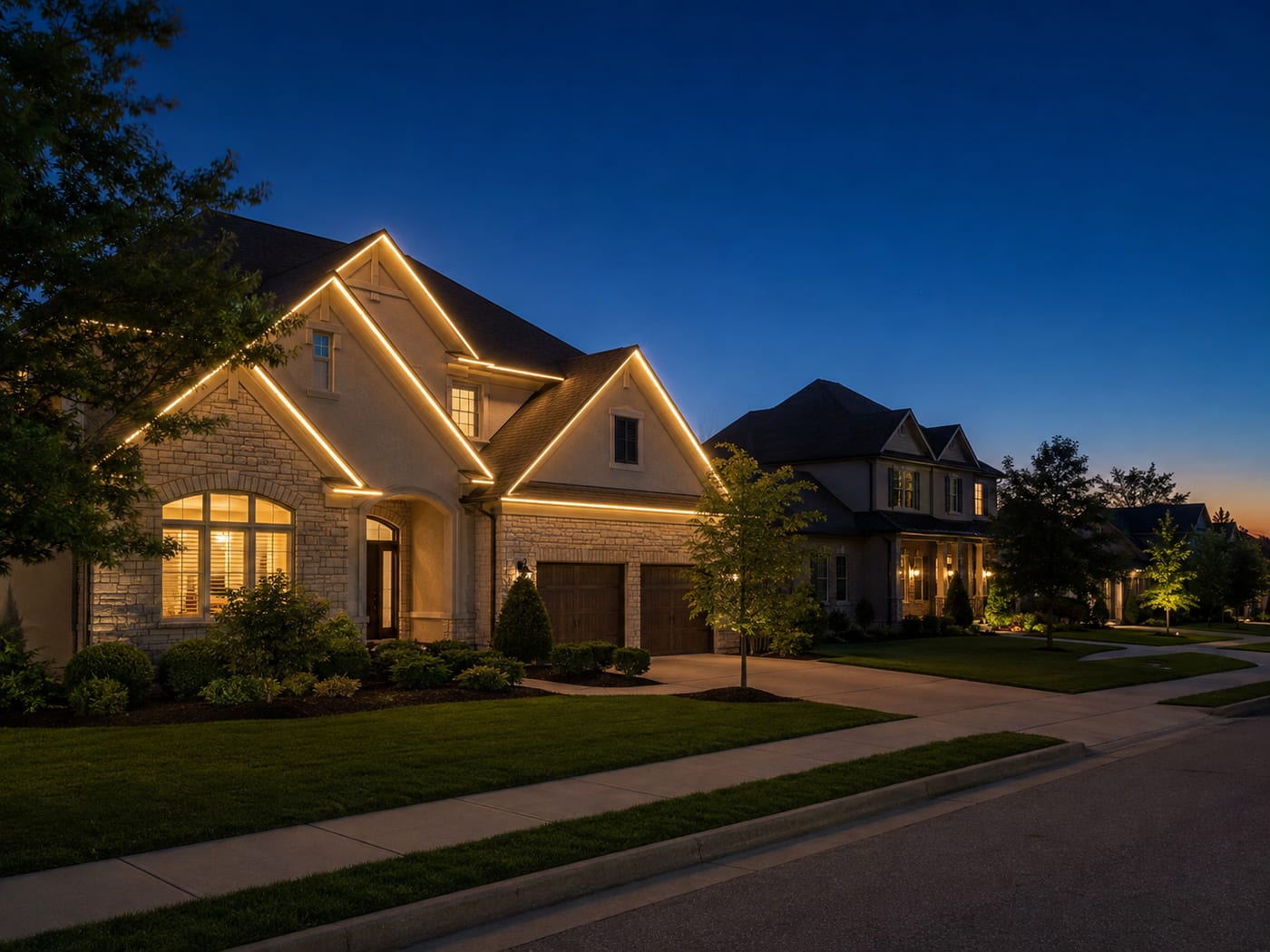
Ask an owner a year in which setting they use most, and the answer is almost always plain warm white on an ordinary evening. Not red and green. Not a light show. Just a clean line along the roof that makes the house look finished after dark, in the way good architectural lighting does on a commercial building.
Christmas ends up being one week of a much longer list. Orange through October. Red, white and blue in July. Warm amber for Thanksgiving. Blue and orange on a Saturday when the game is on. Pink for a birthday. Green in March. School colours the night of a graduation.
None of that happens with strands in a box in the garage, because nobody is getting a ladder out for St Patrick's Day. The product gets bought for December and used in July.
It doubles as security lighting
This gets less attention than it deserves, and it has nothing to do with decoration.
A lit roofline and lit approaches make a property look occupied and make it much easier to see around after dark. Entrances, the driveway, the walkway, the dark gap down the side of the garage. That is a real deterrent and a real safety improvement for anyone coming home late or putting bins out in January.
The difference from a motion-sensor floodlight is that this reads as intentional rather than defensive. You get the benefit without the house looking like it is worried.
It looks better than the alternative
Worth saying plainly, because for some people it is the reason they call.
String lights are visible hardware, however carefully they are hung. You see the strand, the clips, the sag between fixings, the lead running down the wall to a socket. From the street they read as decoration attached to a house.
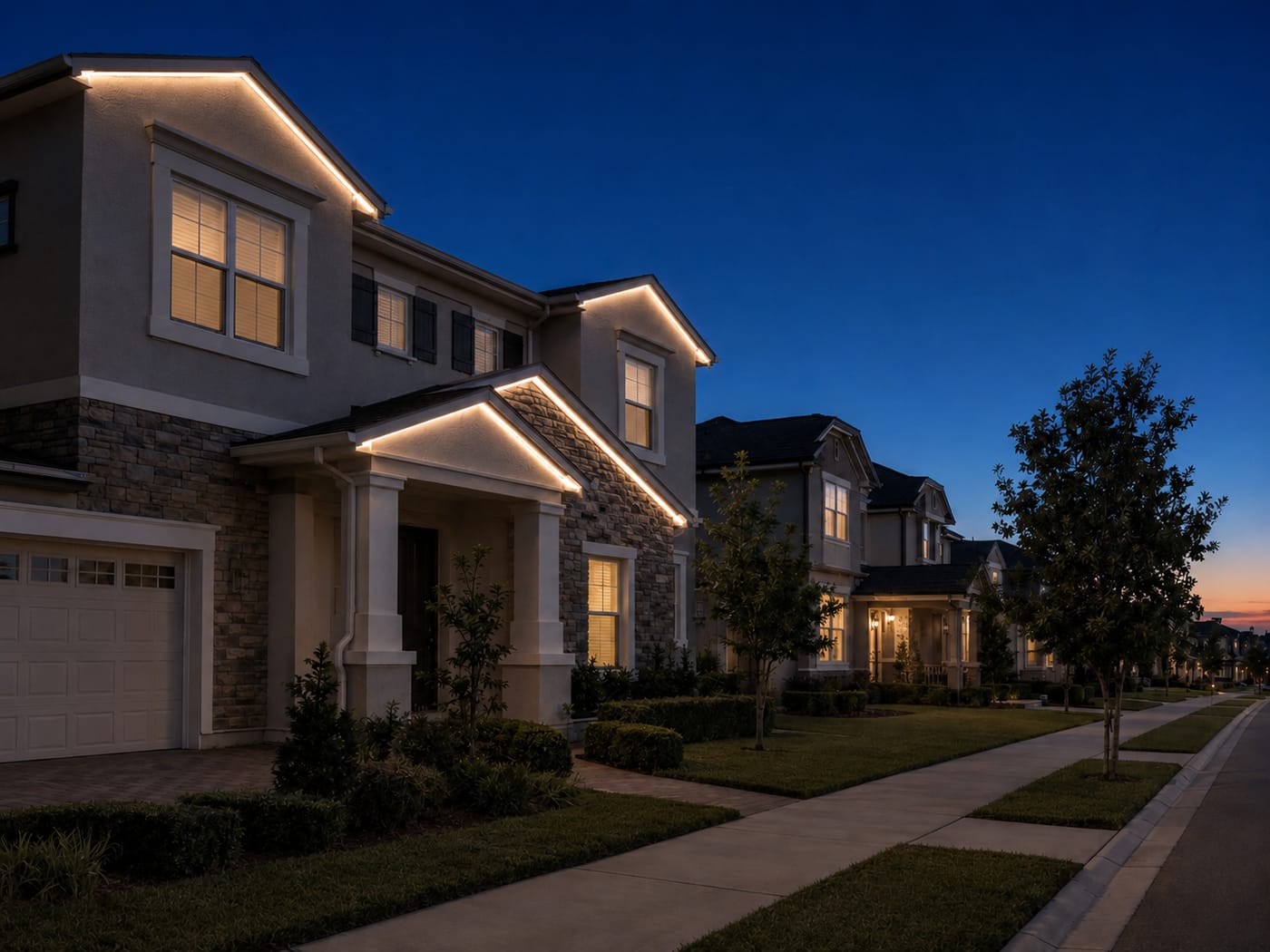
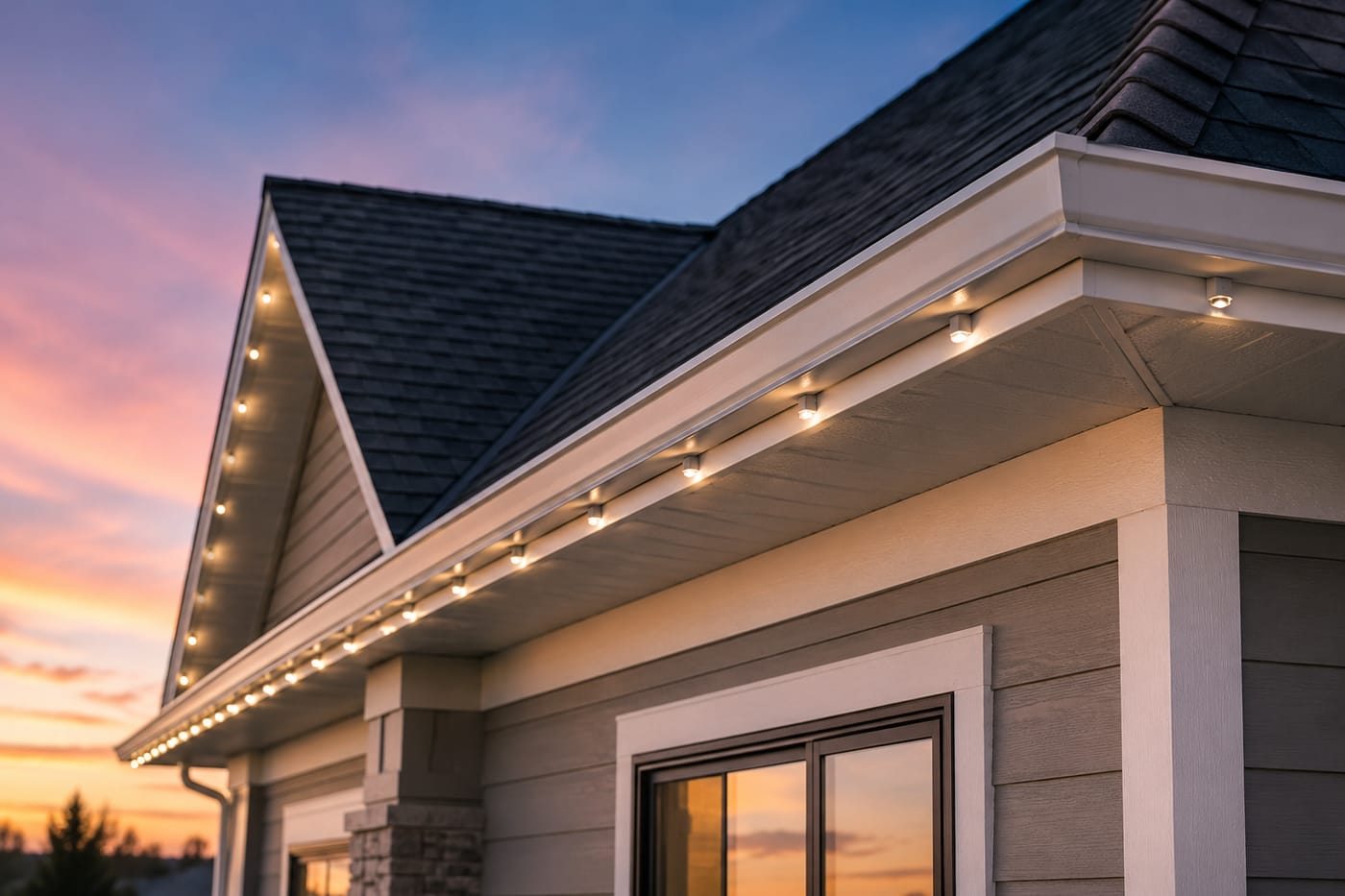
A properly fitted permanent system reads as the house. The track sits in the eave line, colour-matched to the trim, so in daylight there is very little to notice. After dark you see an unbroken line following the architecture with no visible source. That is the difference between decorating a building and lighting one.
Who should not switch
We would rather lose a quote than fit a system somebody did not need, so here is the honest counterargument.
If you genuinely enjoy the ritual, keep it. For some families, putting the lights up is part of the season. Permanent lighting takes that afternoon away from you, and that is a real loss rather than a rhetorical one.
If you are moving within a couple of years, the case is weak. It may help the house present well, but you will not be there for the years of use that justify it.
If your roofline is short and simple and you are steady on a step ladder, the annual job you would be replacing is small. The maths still works. It just works slowly.
If the roof itself is near the end of its life, replace it first. Lighting can be detached and reset around roofing work, but it is cheaper and simpler to fit it to a roof you are keeping.
There is no version of this where we think everybody should have one.
What sixteen years of growth means for you as a buyer
Here is the practical consequence of a category expanding this quickly, and it is the part worth taking away.
Fast growth attracts new entrants. Landscaping firms, electrical contractors, seasonal light installers and general home-services companies have all added permanent lighting as a service line, because the demand is obviously there. Most are perfectly competent. Some were doing something else eighteen months ago.
That changes where your attention should go. The products in this category are broadly good, and the differences between the major systems at install level are smaller than the marketing implies. What varies enormously is who fitted it, how carefully, and whether they will come back in year four when a section stops responding.
The question that used to be which brand is now mostly which installer. Ask how long they have been fitting this specific system. Ask who physically turns up when something fails, and whether they are local. Ask what happens when you need the roof replaced. Ask whether the warranty covers labour or only parts.
Ask us the same things.
What has not changed since 2010
Sixteen years in, the failure mode is still the one it always was. Systems fail because of how they were fitted, not because of what was fitted.
Fixings set wrong work loose after a few Idaho freeze-thaw cycles. Connections sealed badly let moisture in. Track fitted with no allowance for movement distorts in July. None of that is visible on the day it goes up. All of it surfaces in year three.
Which is why the people who install your lighting should be the people who fix it, and why they should be close enough to come.
See what it would look like on your building
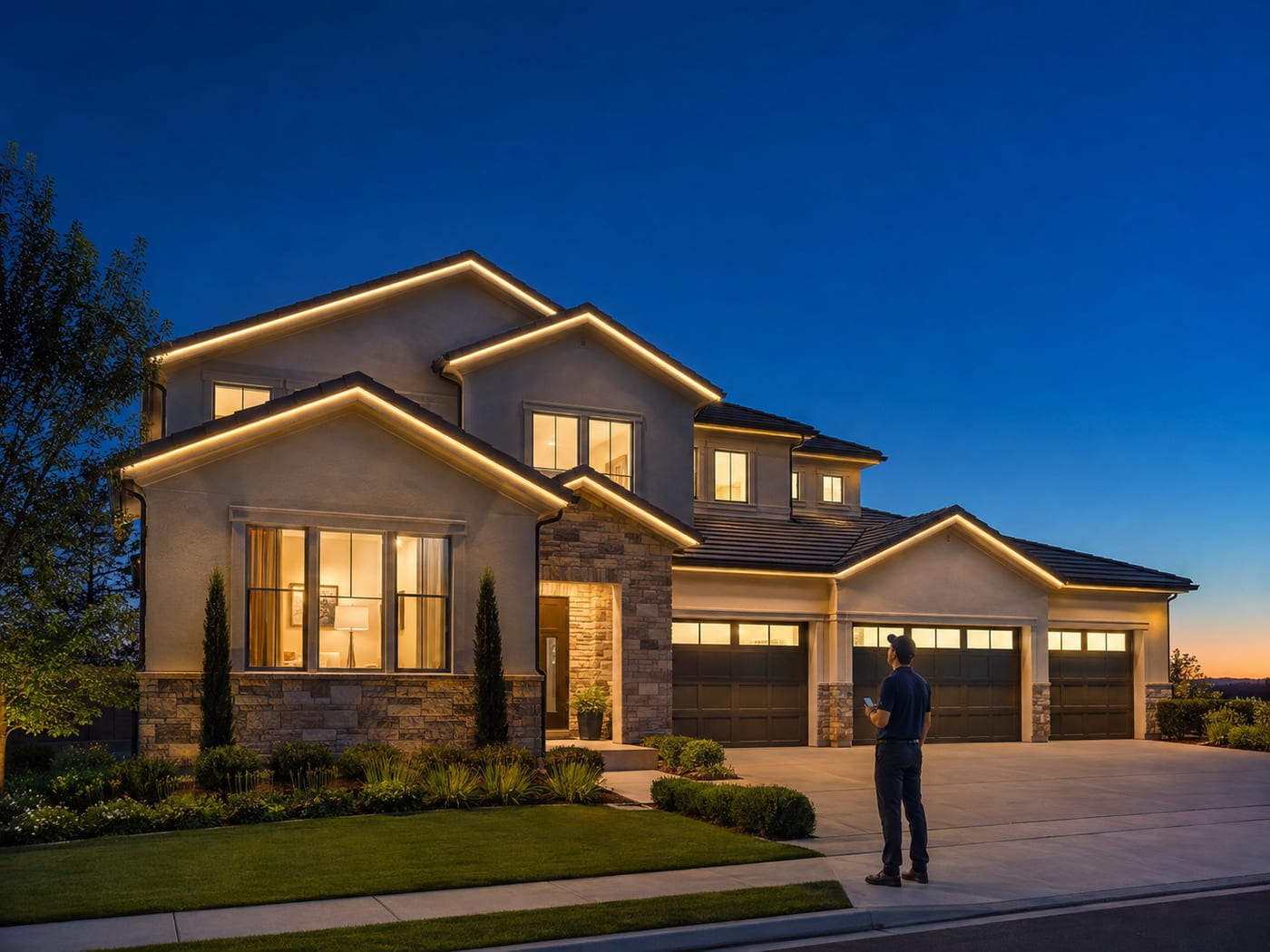
We install across the Magic Valley and the Wood River Valley, we service what we install, and the quote comes from somebody who has walked your property rather than measured it off a satellite image.
Get my free quote or call (208) 242-4252.
Frequently asked questions
How long has permanent roofline lighting been around?
The first permanent track-and-bulb systems came to market in 2010, so the category is about sixteen years old. More than 100,000 American homes have a system installed today.
Is permanent lighting just Christmas lights that stay up all year?
No. It is an architectural lighting system that can do Christmas. Most owners run warm white on ordinary evenings and use colour for holidays, sports and occasions. December is one week of a much longer year.
Why are people switching from seasonal light installation?
Because seasonal installation is a cost that repeats forever and leaves you owning nothing at the end. A permanent system is paid for once and stays on the house. The ladder question matters just as much, particularly on two-storey homes.
Do permanent lights actually help with security?
Yes, practically speaking. A lit roofline and lit approaches make a property look occupied and remove the dark areas around entrances, driveways and side paths, without the house looking defensive.
Can you see the lights during the day?
Barely, when the job is done properly. The track sits in the eave line and is colour-matched to your trim, so there is very little to notice from the street. Systems that are obvious in daylight are usually a fitting problem rather than a product one.
Is it worth it on a smaller house?
Sometimes not, and we will say so. A short, simple roofline means the annual job you are replacing is small, so the payback is slower. It still works, just less dramatically than on a complex two-storey.
Does a permanent system use much electricity?
No. Individual LEDs in these systems draw around a watt at full white, and most owners run warm white at moderate brightness for a few hours an evening. It is a small addition to a power bill.
Should I be choosing a brand or an installer?
Both matter, but the installer matters more. The major systems are broadly comparable once fitted. Installation quality and local service after the sale are where the real differences show up.