Outdoor & Event Lighting
Will Permanent Lighting Damage My Roof, Fascia or Soffit?
TL;DR
- Properly fitted, no. The track mounts to the fascia or soffit, which are trim boards. It does not go through your shingles, your underlayment or your roof structure.
- Badly fitted, yes it can. Wrong fasteners, no sealing, or anything driven through the roof surface will cause problems, usually two or three years later.
- Your roof warranty covers the roof. Fasteners into trim are not the same as penetrations through the roof field, which is what warranty language is actually concerned with.
- The bigger risk is what most people already do. Roofing contractors are consistently more worried about annual holiday lights than about permanent systems.
- December is the worst month to be fixing anything to a roofline, which is exactly when seasonal lights go up.
- Ask any installer where the fasteners go. If the answer involves shingles, gutters or the drip edge, get a different installer.
The short answer, and then the honest one
The short answer is that a properly fitted permanent lighting system does not damage your roof, because it never touches your roof.
The honest answer is that this depends entirely on who fits it. A track fixed with the wrong screws, into the wrong material, with no thought given to sealing or seasonal movement, can absolutely cause damage. It will not look like it on the day. It will show up in year three as a soft patch of fascia or a stain on a bedroom ceiling.
We would rather explain the difference than tell you it is impossible to get wrong.
Where the system actually mounts
This is the part that resolves most of the worry, and it is worth being precise about the words, because they get used interchangeably and they should not be.
Your roof is the shingles, the underlayment beneath them, and the flashing. That is the weatherproof system, and it is the thing nobody should be putting holes in.
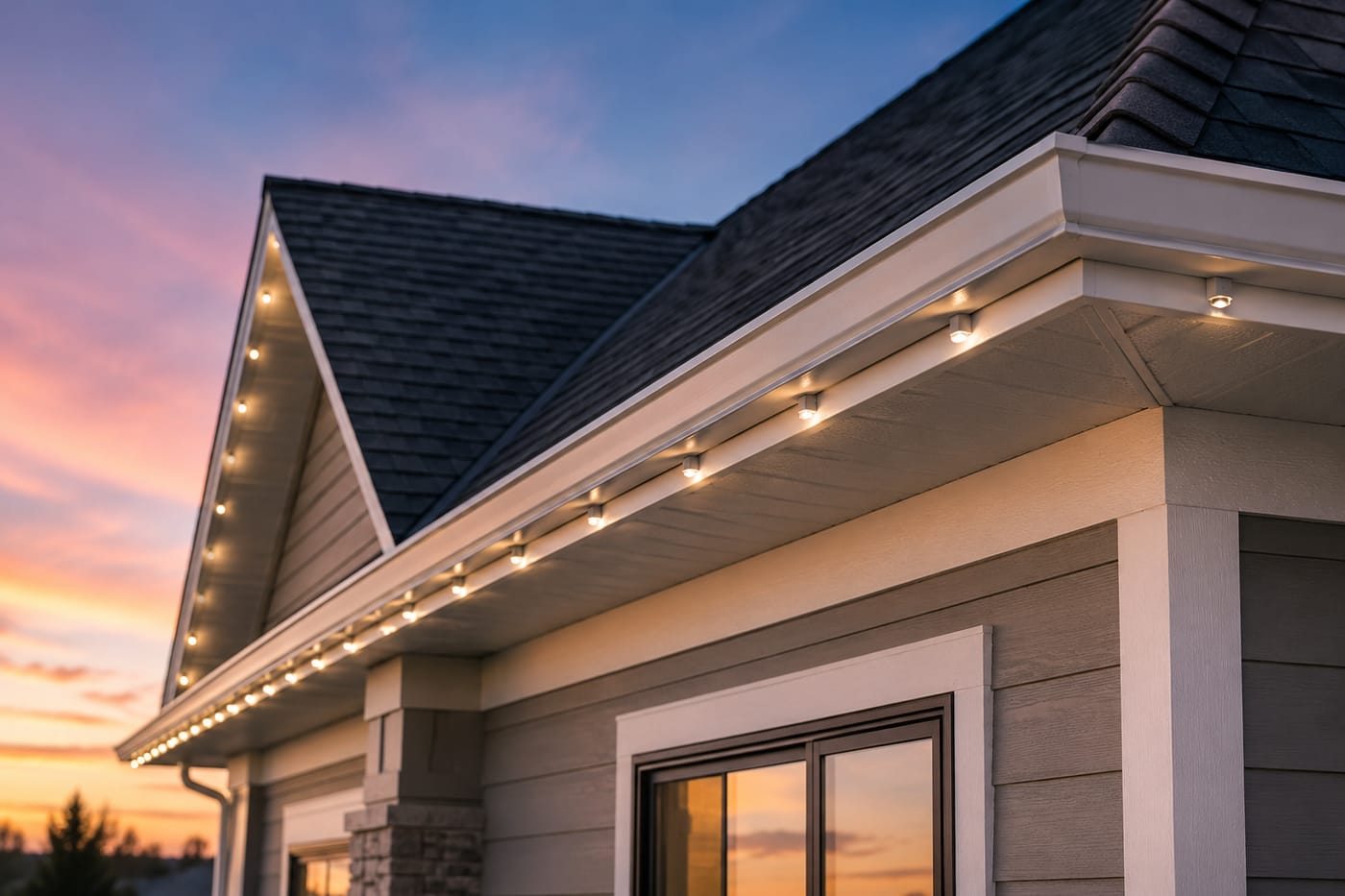
Your fascia is the vertical trim board running along the edge of the roof, the board your gutters hang from. Your soffit is the horizontal panel underneath the eave overhang. Both are trim. They are attached to the roof structure but they are not part of the weatherproofing.
A permanent lighting track mounts to the fascia or the soffit. The fasteners go into the trim board and stop there. They do not pass through shingles, they do not go under the underlayment, and they do not disturb the drip edge.
That distinction is the whole answer. The system is fixed to the edge of the house, not to the roof.
What a good installation looks like
Six things separate a job that will be fine in fifteen years from one that will not.
An inspection before anything goes up. Soft spots in the fascia, lifted shingles, existing water damage. If any of that is present, it needs addressing before a track goes on top of it. Fitting lighting over a problem hides the problem.
Aluminum track, not adhesive. Tape and adhesive mounting works for a while and then does not, particularly through a southern Idaho summer followed by a hard freeze. Heat, snow and rain all break it down. Adhesive belongs on temporary setups.
The right fasteners for the material. Exterior-grade, correctly sized for whether your trim is wood, vinyl or aluminum. Interior-grade screws corrode. Screws that are too long push through the back of the board. Screws that are too aggressive split vinyl soffit.
Sealing at the penetration. Small holes in trim are fine when they are sealed. They are not fine when they are left open to weather for a decade.
Allowance for movement. Aluminum expands and contracts, and southern Idaho gives it a wide range to do it in. Track fitted rigidly end to end with no allowance will distort, and distorted track pulls on its fixings.
Nothing touching the roof surface. No fasteners through shingles. Nothing under the drip edge. No wiring run across the roof field.
If an installer proposes mounting to the roof itself or running wire through the shingles, that is not a preference difference. That is a reason to stop the conversation.
The warranty question
This is usually the real question sitting underneath the damage question, and the answer is more straightforward than people expect.
Roof warranties are concerned with the roof. Manufacturer coverage deals with the shingles and the system that keeps water out, and what jeopardizes it is penetration of the roof field, removal or alteration of the drip edge, work that lifts or breaks the seal on shingles, and installations that sit below the underlayment. Coverage is generally affected at and around the point of penetration.
Fasteners into fascia or soffit are a different thing. Trim boards are not the weatherproofing system, and fixing to them is not a roof penetration.
Two caveats we would rather give you than skip.
Warranty language varies between manufacturers, and if you have an enhanced or system warranty from a specific shingle maker, the terms are worth reading rather than assuming. If yours is recent enough to matter, ask us and ask your roofer before we start.
And there is a separate question about workmanship warranties from whoever roofed your house. That is a different document with different terms. If your roof is new and still under a contractor's workmanship warranty, a quick call to them costs nothing.
The part nobody tells you: the alternative is riskier
Here is the thing that turns this question around, and it does not come from us.
Roofing contractors, who have no interest in selling you permanent lighting, are consistently more worried about seasonal holiday lights than about permanent systems. Their complaints are specific. Staples and nails driven through shingles or flashing break the waterproof seal. Hooks screwed into gutters create drainage problems and damage the gutter. Nails into fascia and soffit open paths for water, leading to rot and mold. Small holes go unnoticed for years and then cost thousands.
There is also a timing problem that almost nobody thinks about. Seasonal lights go up in late November and December, which is precisely when shingles are cold and least flexible, when seal strips are hardest to reseal, and when fasteners do not grip the way they do in warm weather. Then snow and ice load onto whatever was fixed up there. The damage often does not surface until spring, when the gutters stop draining properly.
Even the popular workaround has a question mark over it. Shingle tabs that slide under the shingle to avoid a fastener are widely recommended, but at least one major shingle manufacturer warns they can break the wind seal.
Meanwhile roofing companies rate permanent track systems fixed to trim boards as a very low damage risk, and some recommend them specifically as the safer option.
So the honest framing is this. If you are worried about your roof, the thing to worry about is the annual routine, done in the cold, with clips and staples, on a ladder, by somebody in a hurry. Not a track fixed once to your fascia by somebody who was not in a hurry.
What about when the roof does need replacing
It will, eventually, and this is a fair question.
Permanent lighting does not prevent a roof replacement. The affected runs are detached before the roofing crew starts and reset afterwards. It is a straightforward job and it is one of the services we provide.
What causes problems is nobody telling anyone. A roofing crew that does not know the track is there, or does not know how it comes off, can damage it, and damage caused during another trade's work is not a warranty claim. The same applies to solar installations, gutter replacement and siding work.
One phone call before the work starts avoids all of it.
Questions worth asking any installer
Ask these of every company quoting you, including us.
- Where exactly do the fasteners go? Ask them to show you on a photo of your own house.
- Will anything penetrate the shingles, the underlayment or the drip edge?
- What fasteners do you use, and are they matched to my trim material?
- Do you seal the penetrations?
- Do you inspect the fascia and soffit before fitting?
- What happens when I need my roof replaced?
- If something does go wrong in year four, who comes out, and where are they based?
A company that fits these properly will answer all seven without hesitating.
Have a look at your roofline with us
The only way to answer this question for your house specifically is to look at your house. We walk the property, check the condition of the fascia and soffit, and tell you honestly what we find, including if the answer is that something needs attention before lighting goes anywhere near it.
Get my free quote or call (208) 242-4252.
Frequently asked questions
Do permanent lights go through my shingles?
No. A properly fitted system mounts to the fascia or soffit, which are trim boards at the edge of the roof. Nothing should penetrate the shingles, the underlayment or the drip edge. If an installer proposes otherwise, find a different installer.
Will permanent lighting void my roof warranty?
It should not, because roof warranties are concerned with penetrations of the roof itself, and a correctly fitted system does not make any. Terms vary between manufacturers though, so if you have a recent enhanced or system warranty, read it or ask your roofer before you proceed.
Can the fasteners cause leaks in my fascia?
Not when they are the right size, exterior grade, matched to the trim material and sealed. Leaks come from the wrong screws, unsealed holes, or fixings that were never right and worked loose over a few freeze-thaw cycles.
Is adhesive mounting safe for my house?
It does not damage anything, but it does not last. Adhesive and tape break down under heat, snow and repeated rain, which is why they belong on temporary installations rather than permanent ones. A failed adhesive run is more a nuisance than a hazard, but you will be paying to have it done again.
What if my fascia is already rotten?
Then it needs repairing first, and a good installer will tell you so rather than fitting a track over it. We check the condition of the trim during the quote visit and we will say if we find something.
Can I still replace my roof later?
Yes. The affected runs are detached before the roofing work and reset afterwards. Tell us before the crew starts, since damage caused during someone else's job is not covered.
Is permanent lighting safer for my roof than hanging lights every year?
In the view of most roofing contractors, yes. Annual installation involves clips, staples and nails near the roof surface, carried out in cold weather when shingles are least forgiving, repeated every season. A permanent track is fitted once, to trim, in workable conditions.
Does the track damage vinyl or aluminum soffit?
Not with the correct fasteners. Vinyl in particular needs screws sized and driven appropriately, since overtightening or oversized fixings will split it. This is a workmanship question rather than a product one.